The One She Picked

(///overturned.strawberry.confinement – Aphrodite’s Rock, Cyprus)

Laura never forgot the moment when they had first locked eyes. They had been working along the same row from opposite ends and each had spied a particularly fine strawberry. They both grabbed for it and their fingers briefly brushed against each other. They looked up at one another, held each other’s gaze for what felt like an eternity, and then he had graciously stepped back and allowed her to place it into her punnet.

As they continued to work in the warm summer sunshine, they exchanged glances, but both seemed to lose their nerve when there was a chance to speak. And after a few short weeks, when the farm thanked them for their efforts and they went on their way, Laura found herself pacing up and down, determined to go and speak to him. But when she looked for him he was gone. And so that was that.

Except that it wasn’t. The memory of him lingered, always just on the periphery. And a couple of years later she was browsing online when his face suddenly popped out. The same wavy hair and those eyes which she had gazed into. But the expression was different. This was not him in the sunshine with a look of health and energy. This was him pallid. This was a mugshot.

She read with horror that one Sebastien Durand had been found guilty of murdering his brother in the garden of their home in the south of France, and he had been sentenced to life in prison. Laura found herself crying. She didn’t know this man, had never known this man. And yet she sensed this was wrong, that he couldn’t be guilty.

Her friends told her she was being ridiculous. She couldn’t possibly have known what was in this man’s heart when she had failed to get to know him two summers before. She should just forget about it. And she tried to. She went to pubs and clubs. She had a couple of dates with people her friends were certain were right for her. She tried to move on from something that she knew was a fantasy. But deep down she kept being tugged back, it seemed too real. She couldn’t have felt those deep and irrational feelings for someone with evil in their heart, she wouldn’t countenance it. And as she sat and imagined him in his confinement, sitting solemnly in a bare cell with no light and no hope, she determined to help him.

It became an obsession. She read all the background to the case. She did a crash course to revise her school French. And then she booked some time off work and travelled to southern France, to the area where the crime had happened.

Sebastien had been found guilty because he was holding the knife, over his brother Lucien’s body, when a neighbour saw him over the fence. His DNA was all over the scene. Nobody else’s was ever found. Nobody else had been seen in the vicinity. His story that he had discovered the body a few minutes before, had pulled the knife out and just stayed there in shock was never believed. ‘The obvious justification that all killers fall back on’, the prosecutor had said.

After a few days of toil, Laura sat in a café, nibbling on a pastry she barely tasted, and looked again over her notes. It was true that the brothers had been close growing up, always outside playing, thick as thieves. But the prosecution had claimed they had become more distant as adults and alluded to an overheard argument about caring for their mother’s health issues, claiming it represented some discord, a disagreement that might have led to murder. And the circumstantial evidence seemed to point to Sebastien as well. A scribbled note had been sent to Lucien urging him to return home, written unusually in green ink, the maverick colour known to have been favoured by Sebastien. And Lucien had apparently texted Sebastien to return, but prosecutors argued that Sebastien had done that himself to throw police off the scent.

Laura stared mournfully at her undrunk coffee. Her belief that he was innocent felt unshakeable. But feelings can wilt when faced with facts, and the more she stared at those facts, the more she knew that it was time to head back home and put this behind her.

But as she trudged back to her hotel, thinking about checking flight prices, she couldn’t escape the sense that she was being led to a conclusion that wasn’t true. The motive, such as it was, wasn’t enough. And it wasn’t proven, the argument had only been the word of the neighbour. The neighbour who had also alerted the police after seeing Sebastien in the garden. The neighbour who had apparently been furious with the brothers years before, when as children they had kicked a ball over the fence and shattered parts of his greenhouse, destroying his award-winning tomatoes.

What if this resentment had festered for years? She got back to her room and started to research once more. She knew his name and after an hour of so of searching she discovered that he hadn’t won prizes at the annual horticultural show for years, not since that incident in fact, while prior to that he had been a regular champion. Had he plotted revenge for years and finally sensed his chance? After all, he was the only witness to everything, and yet he had never been questioned. What if he had sent the note?

There had been a photograph published of the original. Everyone had focused on the colour rather than the handwriting itself. But what if she could somehow match the handwriting to the neighbour’s, then she could have a case. But how to get him to write something down. Well that proved the easy bit. She arrived at his door with a petition against the recent local decision to cut down some historic trees. It was straightforward to convince him to sign it and write a comment. It was enough.

She went to see a handwriting expert. The match was quickly confirmed. She went to see Sebastien’s lawyer to ask if it was sufficient evidence to appeal, to have the verdict rescinded. The lawyer spoke to the police. The police spoke to the neighbour. By all accounts, he sat down quietly, smiled ruefully, and said he thought the green ink would have been enough.

Within weeks, Sebastien’s guilty verdict had been overturned. He clasped his lawyer and as bedlam ensured in the courtroom his parents rushed towards him, overwhelming him with hugs.

As the emotion subsided, the lawyer told Sebastien that he would never have been freed if it hadn’t been for a young English lady who had tirelessly striven to prove his innocence, her motivation unknown. Sebastien said he would like to meet her.

The lawyer guided Sebastien to a quiet room behind the courtroom and led Sebastien in. There stood Laura, holding a strawberry.

They locked eyes and didn’t look away.

_______________________________

Why This Location?

Our Survey Says

(///state.richer.bronze – Ipsos, London, UK)

Margaret was bored. Her boys were pretty self-sufficient now, teenagers who knew everything. Raymond was either at work or on the golf course. Her part-time job at the carpet company was undemanding and gave her spending money which she frittered on unnecessary clutter. Her life had metamorphosed into something perfectly pleasant but unutterably tedious, a conveyor belt of activity over which she had no real influence.

She only really filled in the online survey to kill a few minutes. She thought it unlikely she would win an Amazon voucher for sparing two minutes of her time to say what she thought of the water bottle she had recently purchased, but she did it anyway. Frankly it was nice to be asked what she thought of something, for a change.

But somewhere in the online world, answering one survey seemed to tell the survey gods that here was someone they could count on, and her inbox flooded with requests for multiple opinions. Soon she was describing her recent visit to the Golden Spot Café, her purchase of discounted super noodles from the local supermarket and even her view of the packaging her previously reviewed water bottle had arrived in.

Surveys bombarded her from every angle and she was happy to reply, enjoying being asked to state what she thought for a change, giving her renewed purpose. And unlike daily life, being critical was not seen as a fault, quite the reverse in fact. When she mentioned she had been disappointed with the speed of service at the florists, she was sent a gift voucher by way of apology. Rating the cleanliness of the local garage as bronze rather than gold meant that her next service would be half price. The more negative she was, the richer in reward she became.

Anonymity was more successful than real life though. Using the same approach with her sons’ attitude to chore completion or conversational engagement yielded nothing but arguments. Raymond didn’t appreciate her suggestions for how he improve his golf swing. But no matter. Her opinion mattered now, and she would no longer hold back.

It was that approach which led her to the bank that Thursday morning for a meeting with the manager, who wanted to discuss why his staff only rated two out of 10 for customer service and how they could perhaps “smile more and provide greater clarity on financial planning”. If she hadn’t been there then she wouldn’t have got caught up in the robbery, and if she hadn’t criticised the robber’s choice of balaclava and the technique he was using to hold his rifle then she probably wouldn’t have been shot in the head.

The world went black before it went white. Visions and confusion flashed in front of her but when all was calm and she could process what she had seen, she found herself sitting on a bench with a kindly looking gentleman next to her.

“Hello Margaret,” he said gently. “You’ve been through an ordeal. But now you are at peace. Welcome to Heaven.”

Margaret looked at him, looked around, and then back at him again. “Thanks,” she said. “Thanks. I’m not sure what to say.”

“Of course, take your time, this takes much adjustment.” He smiled.

“Yes. Those gates, not as shiny as I thought the pearly gates would be. I think you could make them a little brighter, really get them to stand out more, greater impact for new arrivals. And this bench, I think it should be softer, more comfortable, this is heaven for goodness sake. Your wings, they’re a little small, if you want to impress your new visitors, bigger, more magnificent.

“Are you able to arrange a meeting with your manager?”  

_________________________________

Why this location?

The Last Things You’ll See

(///infirmary.deride.budgie – Island of Serifos, Greece)

She was going to be last up again. It wasn’t Miss Higgins’ fault, she knew that. But it was really annoying being called Zenia Zylyftari.

That was probably why she was going to do everything possible to make her appearance at the art expo one for the ages. Her fellow teens would be tired and bored when she came to speak. So give them something spectacular. People love a memorable dessert.

The art expo was the chance for the sixth form art class to show their work to their contemporaries. Everyone in her year would sit in the hall as the artists filed up one by one to wow them and try to take the top prize. It was the event all the art students looked forward to. More so than their audience, they imagined.

Zenia’s alphabetical dysfunction had caused her more than delay in the past. Schoolchildren could be merciless, and over the years had either feigned sleeping in front of her in tribute to her ZZ initials or had donned fake beards to reference some band of ageing rockers she had previously never heard of. Teen life was not easy for someone with a name over which she had no control.

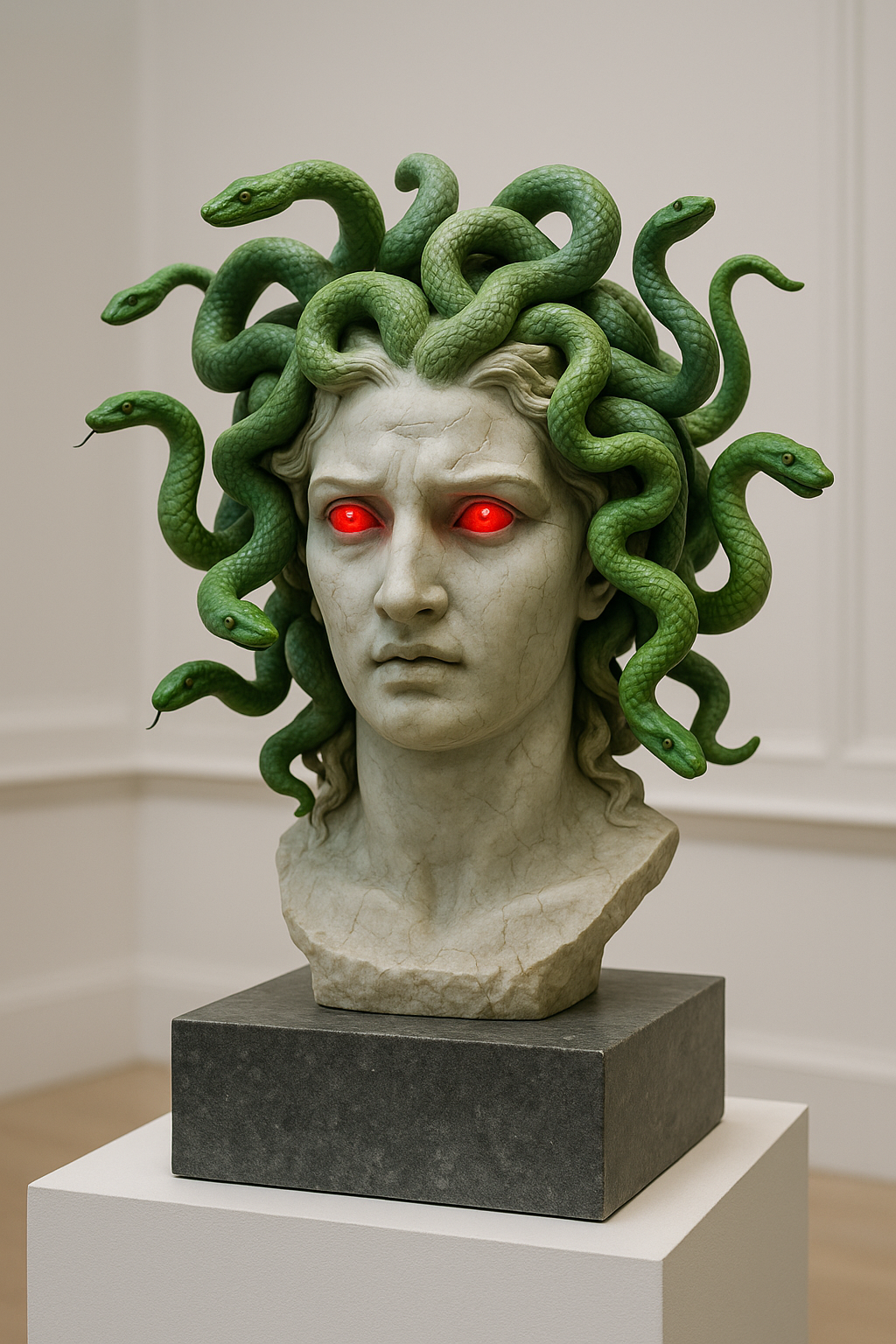
So she had dived into her Greek background to find something which she could relate to, lighting on a misunderstood mythological figure, someone else who through no fault of her own was regarded as an outsider, someone who had developed to become a threat. Zenia hadn’t gone that far in people’s minds, but she felt a kinship as she worked on her masterpiece. 

And yet, as she viewed it the day before, and admired how good it was, she knew it was just that. Good. Not great. And great was what she had wanted.

A new idea came to her. She loved it, this was what would transform it. And she forgot about sleep as she worked feverishly throughout the night to bring it to life.

When the expo started it was hard to keep concentration. It was a hot day. Given that the work was produced by people studying art, she found it curiously bland and unexciting. She liked Melinda’s papier mâché budgie, she admired Charlie’s scale model of a hospital but was annoyed that he had labelled it as infirmary as it showed he had watched too much Netflix, and she wanted to deride Cecily’s oil painting of fruit because it was so old-fashioned, but she was forced to appreciate the brushstrokes.

By the time her turn came round, she could see that people’s focus had long since departed. Always the same for her. But she knew that what she was about to show people would take their breath away.

Zenia had prepared a lengthy preamble, an explanation of why she had chosen to create what she had created. But she could see that everyone just wanted to leave at this point. So why delay. After the briefest of pauses, she took hold of the cloth and with a dramatic flourish, pulled it off and announced: ‘Medusa’s Head’!

People sat up to attention immediately and strained to look at it. Even Miss Higgins could see the attention to detail. The facial expression, the mix of emotions she had captured to reinforce the complexity of the mythological creature. The piercing and sinister fixed stare of her eyes. And then there were the snakes, the scales and tongues of each one clear for all to see, the range of green tints she had used across them giving her hairs individuality.

Zenia paused again. Now for the piece de resistance, her late addition. She said nothing. She left out her reasons for creating her, she didn’t dwell on Medusa’s complex history. She simply reached for the switch on the motor which she had added only the day before, and switched it on.

All the effort paid off. The snakes now started to wriggle and writhe gently on the top of Medusa’s head. The class gasped.

But there was one more thing. One more button press and Medusa’s eyes started to glow, bright red light beaming out from them. And what a reaction. This stunned the hall into total silence. People sat frozen in open-mouthed awe. Miss Higgins was as speechless as the rest of them. It was a total triumph.

As Zenia switched the eyes off and recovered her Medusa, the bell rang for the end of the session. Still nobody moved. Well it wasn’t a surprise really, it was such an amazing piece of art she wasn’t at all shocked that people were still sitting silently, contemplating it. Zenia took Medusa, collected her bag and left the hall. The others would follow soon she was sure, once they had come to terms with her genius.

She couldn’t wait to go home and show her parents.

___________________________________

Why this location?

The Breakfast Thief

(///desk.finds.canny – Malmaison Hotel, Leeds, UK)

Nobody could work out the identify of #thebreakfastthief.

It had been going on for a couple of years now. At first, an obscure Instagram internet account with photos of extravagant breakfasts began to pick up a modest following of people enamoured of eggs and avocados.

Then the narrative behind the pictures began to emerge. The mysterious breakfast thief started to boast that none of those delicious breakfasts had actually been paid for, and that the imagery actually showed the fruits of their larceny.

The Breakfast Thief insisted that this pursuit of free breakfasts was not just about eating without paying. It was also about exploiting the system, showing hotels the flaws in their breakfast routines, protecting breakfast for people who had paid for it.

The process was relatively simple. The breakfast thief tended to work shortly after service opened – they were adept at staring at the list of room numbers at the desk at the front of the breakfast area, and then supplying a number that they could see had not yet been ticked off. Nobody ever checked for a name or a room key, they simply asked whether they had eaten breakfast there before.

And so the breakfast thief was able to drink copious juices, tea and coffee, indulge in fruit, pastries and hot treats from the buffet, or order breakfast classics from the menu. And nobody ever knew that they weren’t supposed to be there.

Of course there were scares. There were times that the person whose room number they had stolen came down and stood looking a little bewildered, explaining that they would remember if they had already eaten breakfast and could they please just sit down. The staff would inevitably just relent, assuming a mistake had been made with a different guest, but occasionally they would scan the room, seeing if they remembered who had quoted that room number, even though that information had been forgotten almost as soon as it had been imparted. And of course there was the morning in Bristol when the thief was almost rumbled and had to crawl under the tables to get away, knocking over three chairs and a samovar during their escape.

As The Breakfast Thief’s fame grew, so the stakes got higher, with hotel chains offering ‘a free breakfast to whoever finds the thief’, seemingly without recognising the irony. The thief grew more canny about their breakfast choices, ever earlier starts, scoffing rather than savouring. The energy seemed to go out of the postings – as follower numbers boomed so the new material became more infrequent, the risk of being caught beginning to eliminate the thrill of the free French Toast.

And then the posts stopped. At first, nobody realised. After all, a couple of weeks without a breakfast thief post was nothing, garnered no comment. But three weeks, four weeks, a couple of months – suddenly it began to dawn on the hordes of followers that #thebreakfastthief was no more, that the hunt for free breakfast had simply stopped with no announcement, no fanfare.

Fans felt short-changed – they would never know who the breakfast thief had been, what they had done before and what they were doing now. And then people moved onto other things, and hotel breakfast staff could relax once more.

A few weeks later, an Instragram account called #thedinnerthief went live.    

______________________

Why this location?

Philm Stars

(///lifeforms.perceptual.pasts – Atlas Film Studios, Ouarzazate, Morocco)

“He’s ruining it for everybody,” Malcolm muttered for the umpteenth time under his breath.

“Sssh dear,” Maureen replied for the umpteenth time. “It’ll soon be over.”

“But that’s just the point,” Malcolm hissed. “This was going to be the highlight of our trip. And he’s ruining it for everybody.”

Maureen smiled indulgently. “You mean he’s ruining it for you.”

In that assertion she was largely correct. Most people in the tour group were allowing the ramblings of the gangly figure with his notebook to just wash over them, nodding indulgently and then moving discreetly away. But Malcolm couldn’t seem to shake him, forever finding himself having to listen to those wild theories.

So instead of enjoying anecdotes about the many films that had been made in the desert studio and admiring the impressive range of authentic sets, statues, plants and other lifeforms from across Egyptian, South American, Roman and Chinese history, he instead had to endure a man who identified himself as an amateur archaeologist with unique perceptual skills, a man who was convinced that this film studio actually gave credence to the theories in his self-published series of books The Scripts of History.

The tour ended and Malcolm was finally able to relax and salvage what he could of the day. But on the coach back to the hotel he found he couldn’t shake the nonsense his brain had been subjected to for the previous hour.

It’s true, he was amused by the notion that if someone dug up the film studio site in 500 years’ time, they might well conclude that a range of diverse cultures had lived harmoniously in close proximity to one another, leading to a raft of inaccurate historical conjecture.

But to extrapolate from there that most of history was in fact derived from fiction, that historical figures were simply the acting stars of their age, and that the accounts of ancient pasts uncovered from tablets and carvings were not fact, they were scripts or novels or publicity material, well that seemed a step too far. Malcolm needed to stop filling his brain with such nonsense and just focus on remembering what he could from the afternoon’s excursion.

**

Nimlot was exhausted. He sat down and handed his robes to a runner, who gave him a mug of beer and a plate of pomegranates and dates in return. He stretched his feet out and surveyed the sands beyond him, ripping up his papyrus script and tossing it into a basket.

He could hear people chiselling away behind him, committing the tale of the Battle of Kadesh to stone so that it could be taken the masses to drum up excitement ahead of the first performance of new Ramses II adventure. He was already looking forward to first night after party and spending more time with Bastet. Her performances as Nefertari had brought them close during rehearsals, and he knew that they would continue to work together for many years to come if off-screen romance blossomed.

He wouldn’t miss Giza. The pyramids were sometimes too dark for rehearsals, notwithstanding the drama they gave to performances. The new city being built, which he had heard would be named Pi-Ramesses in honour of the long-running Ramesses franchise, promised better facilities and opportunities for more expansive story telling.

Nimlot sat back. Acting brought pleasure to millions. It didn’t matter that he and his stories would be forgotten by history, it was enough to make people happy now. He drank his beer and smiled.

_______________________

Why this location?

Spy Duck

(///range.linked.regime – Black Park Country Park, Buckinghamshire, UK)

Ducking Useless: A Bizarre Cold War Failure, by Duncan Smithson, Europe Correspondent

The trove of recently declassified papers from the Government has given people a fascinating insight into the lengths that spy chiefs went to in their efforts to entrap suspected spies at the height of the Cold War.

Yet while social media debate rages over whether the Brandenburg Concerto Sting or the Beans on Toast Gambit was more ludicrous, a new contender has emerged from the leafy quiet of a country park.

There had long been suspicion that Economics Professor Ernest Jameson was using his role as a respected academic to feed information back to the regime in Moscow. However, no tangible evidence was forthcoming, and MI5 chiefs were preparing to move on to other targets.

The newly released documents detail how the desperate spooks became fixated on Professor Jameson’s regular visits to a local lake and resorted to an elaborate operation to try and gain the information they needed.

Jameson visited the lake every Saturday morning to allow his son to feed the ducks, but it had been noted that a revolving cast of men and women would often come to speak to them, and some of these associates had been recognised and linked to other ongoing spying investigations.

To get close enough to the conversation to record what was being said, MI5 set to building a mechanical duck with a camera and recording device housed inside. The plan was for the duck to record what was being said once it was in range, and this evidence could then be used to apprehend their target.

Regrettably, those building the duck had failed to account for Jameson’s son’s love of his weekend visits and his deep knowledge of all of the birds in the lake. He quickly spotted that there was a new duck, but told his father in animated tones how its movement was jerky, unlike the smooth movement of the ducks he recognised, how its feathers shone like metal in the sunlight, and how the webbing on its feet stayed a uniform size rather than contracting in and out as the duck swam along.

MI5 only heard this exchange when the duck returned to them, where the son’s detailed description of the duck’s less than lifelike appearance was followed by Jameson declaiming ‘You will have to do better than that’, before blowing a lengthy raspberry intended for his pursuers.

Jameson vanished from his job within a few days, and though it was rumoured that he resurfaced as Professor Arnold Gilbert in a different area of the country some months later, he was never caught.

The story is another historical embarrassment for the British Intelligence Services, and leaves many wondering why the files were released, given they do nothing beyond making those working at the time look anything but intelligent.

If you knew Ernest Jameson, or you were his son, and you would like to contact us, simply email contact@thescandalpaper.com.

______________________________

Why this location?

Time Capsule

(///games.unrealistic.rice – Highgate Cemetery, London)

It started with the letter. At first Oliver dismissed it as an elaborate hoax. His great-great grandfather Edward Morris had not travelled through time from the 19th century, hand-crafted a beautiful missive with fountain pen on thick, cream paper, stuck a stamp on the envelope, posted it, and then gone back to his own era.

But the more he thought about it, the more intrigued he became, especially when Dominic chided his brother for his scepticism. As he pointed out, the letter contained family details which they knew to be true but which had only been handed down aurally through the generations. He had described in detail the processes he had undertaken to travel through time. And finally he had outlined how they could prove the veracity of what he was saying, as clearly this letter would never be enough.

“That’s all very well,” Oliver retorted. “But nobody is going to let us exhume his body.”

Dominic refused to take no for an answer. The obvious authorities were predictably dismissive but he reasoned that an unorthodox request needed a similar approach. So he started posting snippets of the letter on social media. He got the local newspaper interested. He managed to land a brief radio slot. Television news programmes booked them. A trickle of pressure became a tidal wave as popular opinion demanded that the Morris grave be dug up.

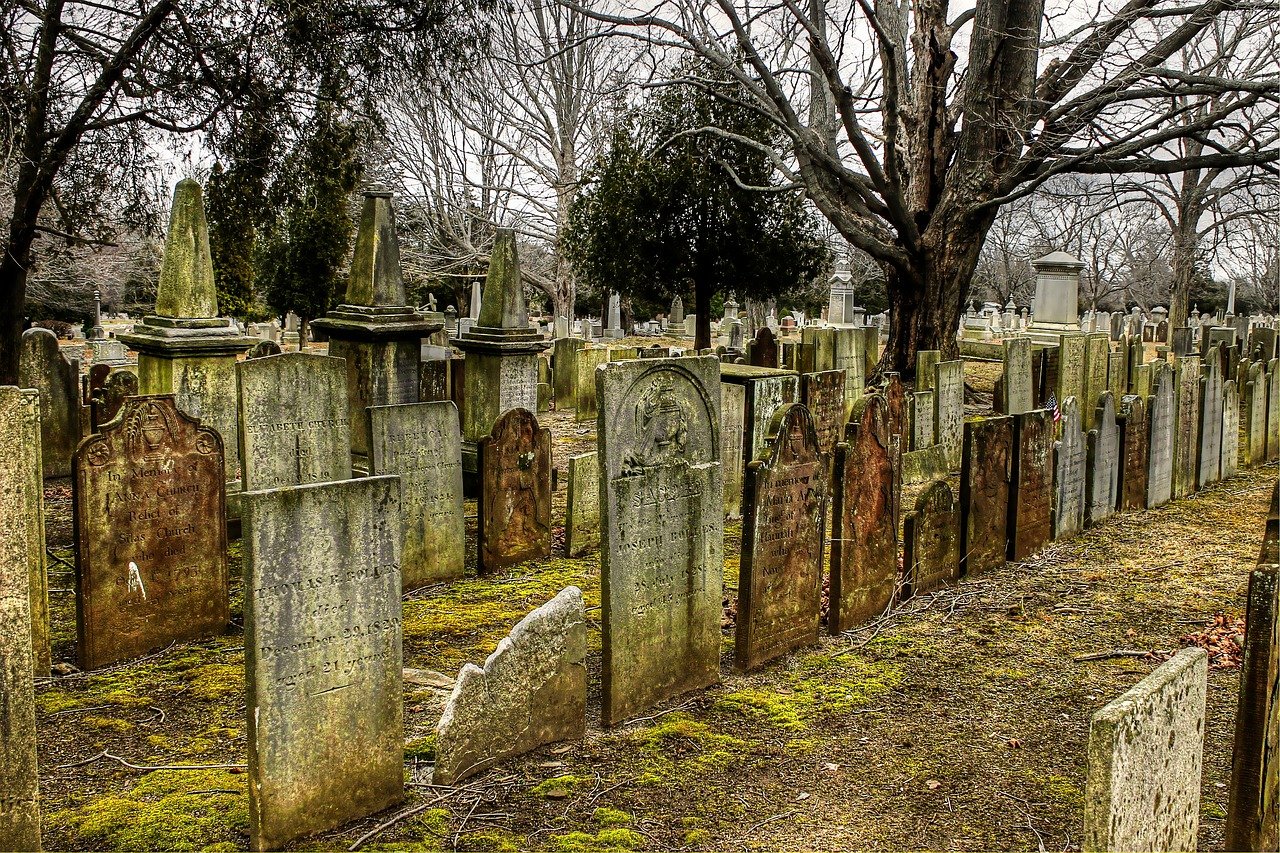
And so it was that Oliver and Dominic found themselves in Highgate Cemetery standing across from a a degraded tombstone, with cameras behind them and diggers ahead, the exhumation about to begin.

“It’s a weird inscription,” Oliver said, remembering that the letter had urged them to pay particular attention to it.

“Pretty hard to read now,” Dominic concurred. But they both broadly agreed that it said: ‘Here Lies Edward Morris. His Games seemed Unrealistic at times, but the truth will prevail’.

“Pretty meaningless,” Oliver concluded. “And those italics don’t help anybody.”

The diggers dug. The brothers spoke to reporters. TV crews scurried around taking various meaningful shots. And after what seemed like an age, a dark brown wooden coffin was brought to the surface and placed gently on the path.

TV channels went live. Everyone else held their breath as the lid was prised open. And Oliver and Dominic advanced with the camera to see what was inside.

They weren’t sure what they were expecting, but the first view was underwhelming. Bones and teeth were still intact, but the sense of a whole skeleton had long since passed. At first there seemed little else to see and reporters were already starting to talk about this revealing nothing special.

“What’s that,” Oliver said.

There were some small metal objects, sitting roughly where the body’s hands would have been.

“He was holding something in the coffin,” Dominic said.

The cemetery staff reached in and delicately took out the objects, handing them to brothers. They turned them over in their hands.

‘They’re small letters,” Oliver said. “What do they mean?” He examined them, turning them over again and again I. R. E C. Irec? Crie?”

“Rice,” Dominic confirmed. “It’s rice. Can’t think of another word.”

They shook their heads. What did it mean? What did it prove? Not much.

Oliver looked at the gravestone again. “The letter said the headstone mattered. Maybe the two words in italics. Games. Unrealistic. And then Rice. No there’s nothing in that. Those three words don’t mean much together.”

Dominic nodded. “Absolutely,” he agreed. “Unless it’s a what3words address of course,” he laughed.

They stared at each other in astonishment and then grabbed for their phones.

__________________________

Why this location?

Derelict Janefield

(///magpie.tracking.loudness – Janefield, Ardbeg, Isle of Bute)

As in a dream I wander
the derelict shell of my old home
from room to room,

a hazy ghost of my past,
a child barely formed,
sidling now into hindsight,

sidling then into parent’s lives,
the heat of family,
the beat of another age.

Then there was headlong push of days,
both carefree and careworn
balancing themselves.

Where once was loudness of youth,
shouts to come in for dinner,
now corvid majesties, crow and magpie,

lord it over these memories,
strut and argue along childhood spaces
tracking through dust and age-long times.

This reverie of revisiting of course can but fail
to halt feelings of inevitable loss
and the measure of close-guarded love.

_______________________________

Why this location? Guest author Laurie Donaldson explains the background to his choice of location. Laurie  is a poet and educator, and has had poems published in Dreich, Blue Bottle Journal, Cold Moon Journal, BRAG Writers Literary Magazine, Ink in Thirds (forthcoming), Power Cut magazine (forthcoming) and the Primo Poetica Collection, as well as anthologies. Follow Laurie on Instagram at @powanpoetry or on X at @LaurieDD